


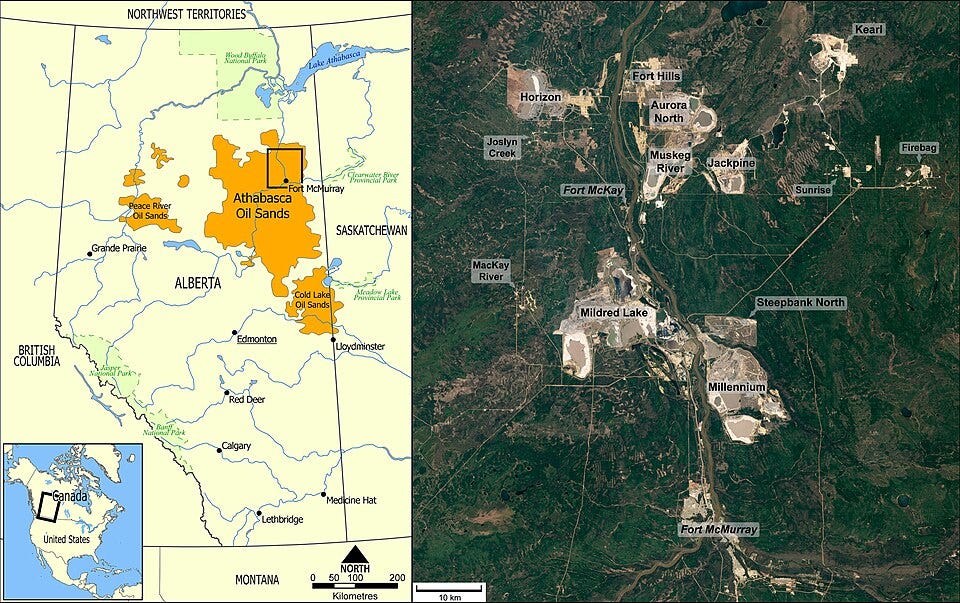
Fort Chipewyan: Located at the western tip of Lake Athabasca, adjacent to Wood Buffalo National Park. It serves as the gateway to the Peace-Athabasca Delta, a region significantly downstream from the industrial projects of the southern Athabasca oil sands. At 58.7°N it is approximately 225 km north of Fort McMurray and more than 1,000 km north of the 49th parallel. Though it lies deep within the Boreal Forest of the 'True North,' it remains under the administrative jurisdiction of Edmonton, a prairie capital located nearly 600 km to the south.
Brandi Morin is Cree, Iroquois and French, and has focused her 15 year journalism career on truth-telling and amplifying Indigenous voices and their personal experiences. There has recently been a series of articles on her Substack blog about Fort Chipewyan, a community downstream of the Athabasca oil sands, which has Cree (Mikisew Cree First Nation), Dene (Athabasca Chipewyan First Nation), Métis. The broader Athabasca oil sands region impacts several other nations under Treaty 8.
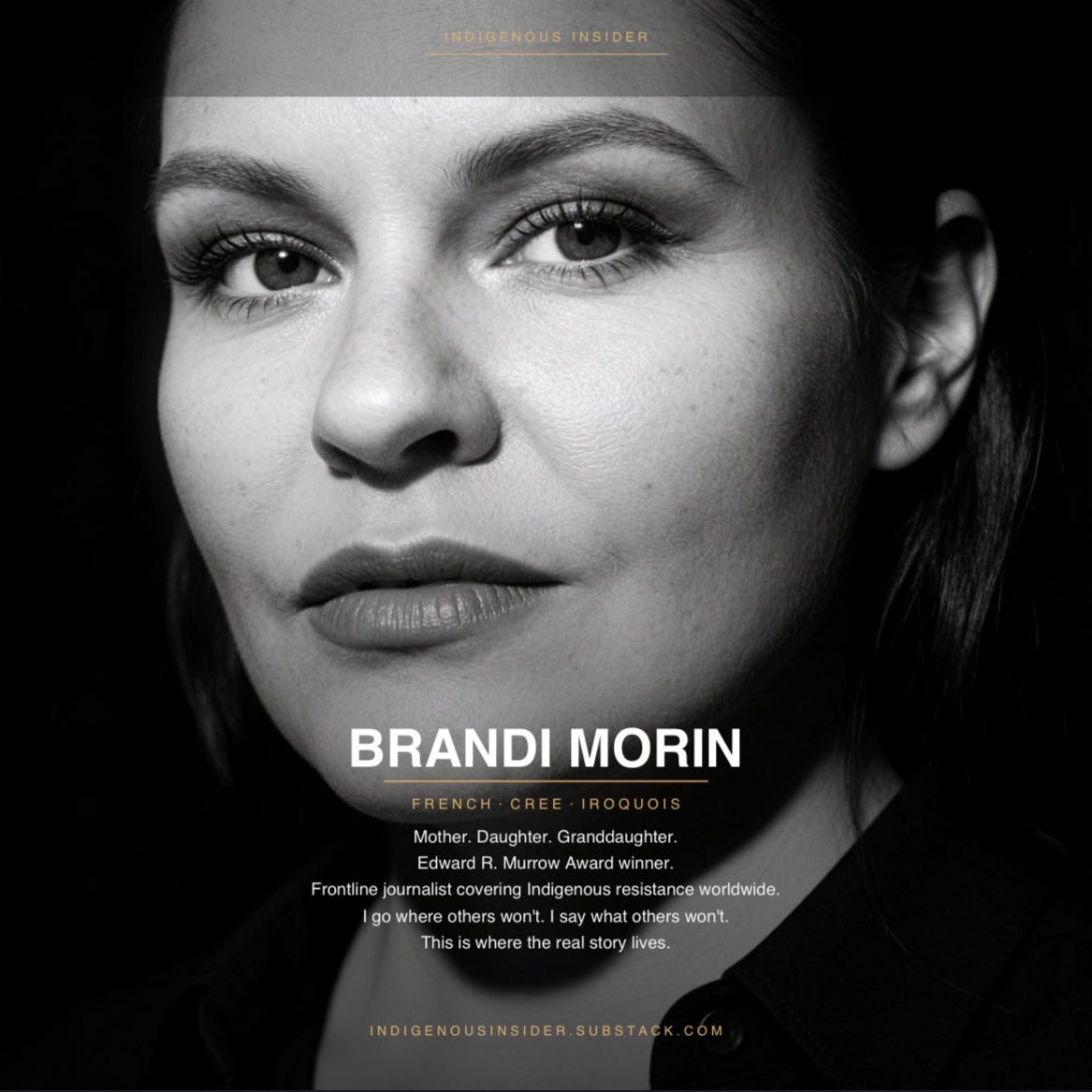

While there is much to be said about this ongoing devastation, there is a specific common response from loyalists to the Canadian Crowns (which includes the federal and provincial crowns) that needs to be addressed.
Why don’t they move?
There are so many ideologies baked into that question which need to be explored, to understand what that question says of the individuals and institutions asking it.
I should first situate myself
I am a settler Canadian of Scottish, Irish and French descent. I have lived on the lands of Anishinaabe peoples my entire life. Being multi-generational on this continent, no longer have personal ties to the lands currently known as Scotland, Ireland or France. I recognize I’m a settler because the only nationality I have was issued by the Dominion of Canada at my birth, a settler-colonial set of institutions. Being a settler is not a statement about myself as an individual, but a statement about the nature of the institutions that claim me as a citizen.

While Brandi Morin and I have some distant ancestral connections to what is now called France and the peoples of that land, our relationship to France will be very different because of the other peoples and worldviews that intersect within each of us,
I have recently become aware of different conceptualizations of sovereignty.
From the unique history of Western Europe came the Peace of Westphalia, signed in October 1648 in Münster and Osnabrück, ended the devastating Thirty Years’ War (1618–1648) in the Holy Roman Empire and the Eighty Years’ War (1568–1648) between Spain and the Dutch Republic. From this grew the concept of Westphalian sovereignty where a single “nation-state” has exclusive control over land and life within a defined geographical region.
On this continent (reminder: Not part of Western Europe), entirely different concepts of sovereignty grew that were based on something closer to the greek word “genos” where sovereignty was of a genos or peoples (relational sovereignty) and jurisdiction over land and life (which includes other than human beings) is non-exclusive.

Westphalian sovereignty has generated conflict with genos/peoples/relational sovereignty ever since. Those loyal to Western European worldviews regularly believe Westphalian sovereignty is the only type of sovereignty that could exist, and even that it is “natural” rather than unique to the history of a small set of peoples within a specific region of the world.
I don’t know how many Canadians think about how unnatural the Canadian government is.
If the territory currently claimed the jurisdiction of the Dominion of Canada were divided based on the average land area of a European nation-state, the result would be a map of approximately 45 to 50 sovereign countries.
If we look at the 1867 boundaries of the Dominion of Canada, and then the territorial expansion since that time, it is clear we are talking about a dominant center and subordinate peripheries. We are talking about a situation where 70% of the population is south of the 49th parallel while 80% of the geography is north of the 49th parallel. In fact, 50% of Canadians live south of 45.7°N (a line that passes through Montreal and the northern suburbs of Toronto).
Canada likes to use the phrase “True North Strong And Free” even in its anthem, when in reality Canada is primarily an example where southern Westphalian capitals harmfully control northern territories.
If we move from foreign Westphalian governance to domestic governance, there are a number of different ways to count. For a Canadian settler audience, maybe the Royal Commission on Aboriginal Peoples (RCAP) would be a good source.
RCAP argued that the “Nation” is the fundamental unit of Indigenous sovereignty, estimating that there are between 60 and 80 distinct Indigenous Nations in the landmass now called Canada.
This is the most direct parallel to the density of Europe. Europe (excluding Russia) has approximately 44 countries within a similar land area (10 million km2).
A “Map of 60 to 80 Nations” would create a political density almost identical to Western and Central Europe, with states like the Mi’kmaq, Mohawk, Blackfoot, and Haida operating as fully recognized sovereign equals with their own diplomatic corps and territorial jurisdictions.
Note: The Mohawk are already part of the oldest League of Nations, which the Eurocentric League of Nations (that later became the United Nations) continues to deny membership.
What about Alberta?
I’ve written about the Alberta Crown before, and how I don’t consider it to be a corporate subsidiary of the Canadian Crown created to manage a permanent foreign workers program for extractive industries.
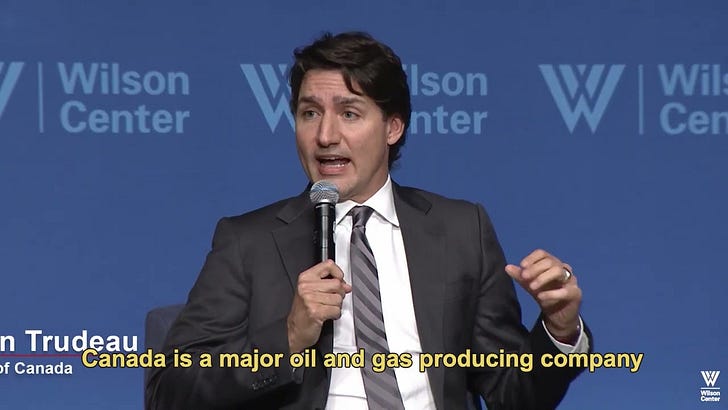
While these institutions (Alberta and Canada) want to claim exclusive jurisdiction to control land and life within a geographical boundary, these same institutions always ignore responsibilities they have to that land and life — always pointing fingers elsewhere for problems originating with these institutions.
The “Hundred Years’ War” comparison
The Hundred Years’ War was fought from 1337 to 1453 between England and France, and predates the wars that led to the notion of Westphalian sovereignty.
Alberta (661,848 km2) is almost exactly the size of France plus England.
France (Metropolitan): approx 543,940 km2
England: approx 130,279 km2
Total: approx 674,219 km2
When comparing these scales, I refer specifically to England, rather than the United Kingdom. The latter is a political project that uses the term 'United' to describe a geography that many Scottish, Irish, or Welsh people might characterize as 'occupied.' By isolating England, we see the true absurdity of the scale: the entire historical and cultural heart of the English administrative model could fit into the single province of Alberta five times over. In the context of the Dominion of Canada the term “Crown Lands” is used in a similar way to promote a notion of being “United” that doesn’t exist at a Genos/peoples/relational sovereignty level where the term “occupied” is more appropriate.
At the time of the expansion of the British and French empires to this continent, they were two peoples who had already adopted the notion of Westphalian sovereignty and many other Western European ideologies. As much as they war with each other, they have far more in common with each other than either does with the peoples/nationalities of this continent since the British and French started to visit in the 1600’s.
Canada has had Eurocentric family feuds between those loyal to England and France since before the Dominion of Canada was created by the passage of the first British North America Act in 1867. That European rivalry was brought to this continent in the early 1600’s, was expressed in feuding on this continent as part of the Seven Years War (1756 to 1763), and can still be seen as ongoing today in the White Nationalist Quebec sovereignty movement.
In the context of the Alberta Crown (imposed by the Canadian Crown in 1905, and delegated jurisdiction over what European worldviews consider “resources” via the Natural Resources Transfer Acts of 1930) we can discuss how a single provincial government in Edmonton (and a very distant federal government in Ottawa) manages a landmass that is comparable to that which contains the entire historical, linguistic, and cultural footprint of the two greatest rivals in Western European history.
When I look at Canada I see an Empire in a Nation-State's clothing. A country this size with a centralized Federal authority and expanded and imposed massive southern controlled Provincial Crowns isn't a "democracy" in the human-scale sense that a Dane or a Swiss person would understand; it is a continental administrative project.

Back to what Canada called the District of Athabasca
If we continue the analogies to Europe, imagine if a distant Russian chartered corporation, operating out of London (capital of England) was polluting massive regions of France and claiming that French people (not merely individuals) who have lived in specific regions of France for centuries should just “move to some other part of Europe” in response to massive pollution from those industries killing French people.
In the case of the Alberta Crown, it is obvious that the boundaries were drawn to be “taller” (north-south) rather than “wider” (east-west) deliberately to allow foreign southern settler governments to control the land and life of northern regions. This conflict and harm isn’t an accident, but a deliberate choice made by the Dominion of Canada governments to further the interests of their extractive projects. The fact that domestic Genos/peoples/relational sovereign nationalities are harmed in the process, diminishing the population of the pre-existing nationalities, is considered a bonus by these genocidal institutions.

This is all the institutions of the Dominion of Canada working as designed.
I think once the unnatural nature of the Dominion of Canada is understood, even if we have to put it into the more familiar context of Europe, then what these foreign Westphalian institutions are causing becomes more obviously wrong. It can also hopefully explain why “just move” isn’t a valid answer to the damage being done to their land and all life (including but not limited to humans) by foreign interests.
A quick note about “population density”.
One of the other objections I hear when these analogies are made is that smaller more sovereign regional governments aren’t needed because the “population density” is low. This is yet another example of importing European ideas into a region that is not European. With domestic relational governments it is not only the human population that is considered, and there is care for creating balance in life amongst more-than-human lifeforms.
Once you move away from Western ideologies such as Anthropocentrism and Androcentrism, you don’t try to increase the human population or allow for “lifestyles” of human populations beyond the carrying capacity of the land. You also move past allowing distant institutions that have no relationship with the land and its life to be making decisions they simply don’t have the capacity to make.
Solutions?
I feel like some clarity is needed for settlers to understand domestic nationalities discussing solutions. Far too often those who are loyal to Westphalian notions of sovereignty look within that ideology for solutions. In the case of this continent, Westphalian sovereignty is itself the problem.
Recognition of existing Genos/peoples/relational sovereignty (First Nations and Innuit) is an early first step to moving away from the ongoing violence caused by foreign conflicting notions of sovereignty.
Provincial Crowns separating from the Federal Crown, and forming new Westphalian (Western European ideological) governments is merely a continuation of the problem. This should be put into the category of Western European (AKA: White) Nationalism. I reject Quebec and Alberta’s Westphalian sovereignty movements, and consider the Bloc to be a White Nationalist political party with seats within the Canadian Parliament.
When First Nations and Innuit peoples speak of “Land Back”, they are not talking about kicking settlers off of land. They are discussing movements to restore genos/peoples/relational sovereignty on this land : it is about different governance structures, not different “individuals”. The fixation on thinking of oneself as an individual is itself an ideology that became prominent within Western Europe’s 16th and 17th century Age of Enlightenment that made populations simpler to administrate via centralized Westphalian states.
There will likely need to be a Westphalian umbrella (a uniting of leagues of nations) over the region, offering shared defense from Westphalian governments who otherwise will claim “terra Nullius” and invade. Westphalian sovereignty needs to be recognized as something that peoples outside of Western Europe need protection from, and is not a concept that protect Genos/peoples/relational sovereignty.


I am a strong supporter of non-metaphorical Decolonization, which can be read about in: Decolonization is not a metaphor
See additional articles on this blog on anti-colonialism