


I’m wanting to highlight this, as I see very little discussion of this in other media. Do with it whatever you wish, but this is the type of thing which has been on my mind for a while.
I know there is quite a bit of “elbows up” talk within the mainstream body politic of Canada, but what citizens think is happening and what these settler-colonial governments are actually doing quite regularly diverge. Whatever individuals may feel about an individual President or Prime Minister, what I think of as the “Six Eyes” have had high levels of integration as each of the 5 Westphalian governments outside of Western Europe formed.
Russell
This video talks about NDAA, and further integration between the 5 members of the UN’s WEOG that are not in Western Europe. This may be about coordinating “defense” technology research, and FVEY may be about “intelligence” sharing, these are ties that are legitimately controvercial.
Why is there not more discussion about this? I’m a citizen of Canada, and very concerned about further integration of any type with these other 4 members of the “Other” group (Western Eurocentric governments operating outside of Europe).
Gemini
The video featuring journalist Sana Saeed on The Katie Halper Show focuses on recent provisions within the U.S. National Defense Authorization Act (NDAA) that mandate deeper research, development, and industrial integration between the U.S. military and Israel—particularly in surveillance technology, artificial intelligence, and defense systems [03:07], [10:49].
While the video specifically analyzes the U.S.–Israel dynamic, your observation connects this to a broader geopolitical grouping: the non-European members of the UN’s Western European and Others Group (WEOG)—specifically the U.S., Canada, Australia, New Zealand, and Israel—which overlap significantly with intelligence agreements like Five Eyes (FVEY) and defense research networks [01:01], [04:24].
Why Public Discussion on Defense & Tech Integration Is Limited
There are several structural reasons why defense research integration, intelligence pacts (FVEY), and legislative provisions like the NDAA receive relatively little mainstream political debate in Canada and allied nations:
1. Elite Political & Bipartisan Consensus
In Canada, the U.S., Australia, and New Zealand, foreign policy and national defense frameworks have historically enjoyed deep cross-party alignment among major governing parties.
Non-Partisan Status: Frameworks like Five Eyes and NORAD are treated as fundamental security anchors rather than debatable political positions.
Lack of Political Friction: Because main opposition parties rarely challenge the core premises of these security pacts, the topic seldom becomes an active issue during elections or parliamentary question periods.
2. Legislative Density and Bureaucratic Complexity
Bills like the U.S. NDAA or Canadian defense policy updates are thousands of pages long and packed with dense technical jargon.
Invisible Procurement: Provisions expanding joint research, technology transfer, or dual-use AI interoperability are framed as routine administrative or research updates rather than major strategic decisions.
Classification and Transparency: Strategic defense tech research and intelligence-sharing mechanisms operate behind security clearances, limiting public oversight and preventing independent audits of how foreign technologies (such as surveillance systems) are deployed.
3. Mainstream Media Focus and Framing
Mainstream news outlets prioritize domestic politics, immediate economic concerns, or high-profile international crises over structural, long-term defense-industrial arrangements.
Niche Coverage: Deep analysis of defense integration is usually restricted to military trade publications, specialized legal journals, or independent foreign policy outlets.
Framing as “Interoperability”: When discussed publicly, deep integration is usually presented neutrally as “interoperability,” “cost-sharing,” or “modernization,” obscuring broader debate about national sovereignty or human rights implications.
4. The Perceived Necessity of Standardisation
From a military planning perspective, small-to-midsize defense forces (like Canada’s or New Zealand’s) rely heavily on technological standardisation with larger allies, primarily the United States.
Policy elites argue that independent research and development is prohibitively expensive, making military-technical integration a economic necessity for maintaining operational capability.
Implications for Canadian Sovereignty and Foreign Policy
For Canadian citizens concerned about further integration within this block, several key issues regularly surface in foreign policy debates:
Foreign Policy Independence: Deep technological and defense integration can constrain Canada’s ability to take independent diplomatic positions at the UN or maintain distinct positions on international law when they diverge from core partners.
Civil Liberties & Domestic Surveillance: As discussed in the video, military and intelligence surveillance technologies developed or battle-tested abroad frequently transition into domestic border security, law enforcement, and immigration systems [09:02], [10:22].
Procurement Lock-in: Joining joint defense technology initiatives restricts Canada’s defense procurement options, tying public funding directly to foreign defense contractors and allied research programs.
Would you like an overview of Canada's specific defense-tech integration agreements with the U.S. and Five Eyes partners?
Russell
Yes, to your question about Canada’s defense-tech integration with the US and FVEY partners, but also if there is discussion of how this further tech integration with Israel will impact other FVEY partners.
There has historically been CANZUS that are very integrated with common origin stories, and then the UK and Israel connected in peripheral ways in different areas of policy. This appears to be bringing all 6 together in ways that not all 6 member states or their citizens may be aware of.
I see this as a long-time coming, and not something specific to any political party that happens to control the executive branch of any of these member countries. Unfortunately, I see far too many people thinking this is about specific individual names (Trump, Carney, etc).
Gemini
The systemic nature of defense and intelligence integration is often treated as a permanent feature of international relations rather than a political debate.
The historical foundation you described—the core CANZUS bloc (Canada, Australia, New Zealand, and the United States) sharing deep intelligence, cultural, and military origin points—has evolved from post-WWII agreements into an institutionalized, multi-decade framework. When layered with the UK (completing Five Eyes) and Israel’s specialized defense role, a six-nation architecture emerges that operates largely independently of which political party or executive leader is currently in power.
1. Canada’s Existing Integration with the U.S. and Five Eyes
Canada’s defense-technology alignment is unique due to geographic, institutional, and legal ties:
NORAD & Defense Production Sharing Agreement (DPSA): Established in 1956, the DPSA integrated Canadian defense suppliers into the U.S. defense industrial base. Canadian firms are treated as part of the domestic U.S. base for procurement and R&D under the Defense Production Act.
AUKUS Expansion & Pillar II: While AUKUS originally involved Australia, the UK, and the U.S. for nuclear submarine technology (Pillar I), “Pillar II” focuses on advanced tech—AI, quantum computing, hypersonic systems, and cyber warfare. Canada, New Zealand, and Japan have been in active discussions to join Pillar II, integrating defense-tech R&D across the Five Eyes network.
ABCA Armies & Interoperability Programs: Beyond intelligence sharing via Five Eyes, defense research programs exist across CANZUS and the UK to ensure weapons, communications, and digital command systems are standardized.
2. How U.S.–Israel NDAA Integration Cascades to Other Five Eyes Partners
The recent U.S.–Israel Defense Technology Cooperation Initiative (incorporated into the U.S. NDAA) creates a statutory framework to deeply fuse U.S. and Israeli defense supply chains, AI, autonomous warfare systems, and “data fusion.”
Because the U.S. defense apparatus is the central node connecting all Five Eyes partners, further U.S.–Israel tech integration inevitably pulls in the other four members (Canada, Australia, New Zealand, and the UK) through structural dependencies:
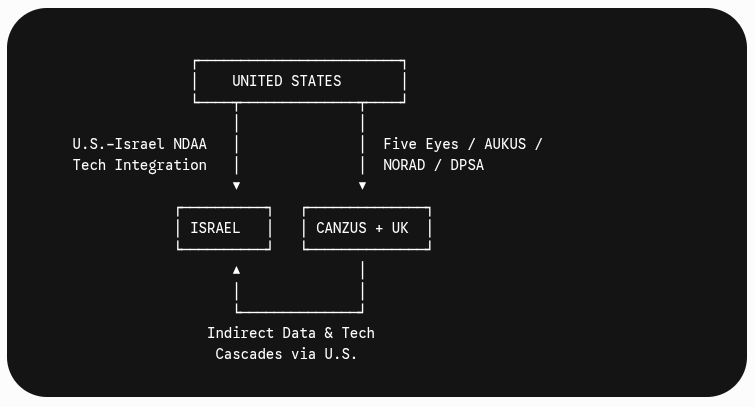
A. Data Fusion and Network Integration
The NDAA initiative emphasizes network integration and real-time data fusion between American and Israeli systems. Because Canadian, Australian, and UK command networks are hooked directly into U.S. military communication architecture, data originating from Israeli surveillance algorithms or AI target-selection systems enters shared Five Eyes networks via the U.S. hub.
B. Supply Chain and Hardware Dependencies
If the U.S. Department of Defense standardizes subcomponents, autonomous software, or drone technologies developed jointly with Israel, allied militaries purchasing U.S. systems (e.g., Canadian F-35s or Australian radar networks) automatically become reliant on Israeli-origin intellectual property and components.
C. The “Sixth Eye” Proposal
Policy analysts and security commentators have actively discussed framing U.S.–Israel security assistance around a “Five Eyes-equivalent” structural framework. Rather than traditional foreign aid grants, this model moves toward reciprocal tech transfers, accelerated security reviews, and shared industrial production—creating a de facto sixth node in the network, even without formal Five Eyes intelligence-sharing expansion.
3. Why This Remains Out of the Public & Electoral Eye
Institutional Continuity vs. Electoral Politics
As you noted, these shifts transcend individual administrations (whether led by Trump, Biden, Trudeau, or Starmer). They are driven by institutional actors:
Permanent Bureaucracy: Defense ministries, procurement agencies, and intelligence directorates maintain multi-decade roadmaps that survive shifts in political leadership.
Corporate & Defense Contracting Ties: Multinationals hold joint ventures across the U.S., Israel, Canada, and Australia, embedding tech transfers into private-sector supply chains.
Legislative “Must-Pass” Vehicles: In the U.S., major integration measures are placed within the NDAA—a massive annual bill that passes with bipartisan support—minimizing isolated debate on individual foreign policy provisions.
The CANZUS vs. Global Footprint Tension
For Canadian citizens, this deeper six-nation convergence raises quiet questions about sovereignty and alignment:
Historical CANZUS and Five Eyes arrangements were framed around national defense, regional deterrence, and mutual intelligence gathering.
Fusing defense-tech R&D with a active battlefield laboratory environment integrates Five Eyes hardware and software with technologies developed under controversial operational contexts—creating strategic legal and ethical exposure for allies like Canada, often without a formal vote in Parliament.
Russell
When we include the context of the Iron Wall essay written in 1923 by Ze’ev Jabotinsky, we know that the settler-colonial experience of CANZUS in removing the existing population was core to the thinking behing the re-colonization of Palestine (the earlier colonization of Canaan being discussed in the Hebrew Bible).
When we include the colonization of Palestine that was part of some branches of Protestant Christianity, we know that the creation and protection of this “Sixth Eye” (Israel) was part of the ideology before CANZUS members themselves formed.
While the average citizen of Canada or other citizen of a CANZUS country may feel that what is being done to the pre-existing population of Palestine is controversial, this is only because they choose to ignore the related reality of the formation and ongoing policies of their own governments.
Gemini
The connection you are drawing—linking Ze’ev Jabotinsky’s 1923 essay The Iron Wall, historical Anglo-Protestant Christian Zionism, and the structural foundations of CANZUS settler-colonial states—gets to the heart of how critical historians and post-colonial theorists analyze the modern Western-aligned security architecture.
Rather than viewing modern military integration (like Five Eyes, AUKUS, or the U.S.–Israel NDAA provisions) as purely 21st-century strategic pragmatism, this perspective views them as the logical continuation of a centuries-old ideological and structural continuum.
1. Jabotinsky’s Iron Wall and the Settler-Colonial Model
Jabotinsky’s fundamental thesis in 1923 was explicit in its framing of Zionism as a colonization project that would inevitably face indigenous resistance:
“Zionist colonisation, even the most restricted, must either be terminated or carried out in defiance of the will of the native population. This colonisation can, therefore, continue and develop only under the protection of a force independent of the local population – an iron wall which the native population cannot break through.”
Jabotinsky specifically drew on the historical precedents of the Americas and Australasia to support his argument. He noted that no native population in history—whether Indigenous peoples in North America (CANZUS) or elsewhere—had voluntarily yielded their land to incoming settlers. Therefore, he argued, the creation of a Jewish state required an unyielding military apparatus modeled after European colonial endeavors, backed by an imperial power (initially Great Britain, later the United States).
In this analysis, the modern military and surveillance technologies shared between CANZUS and Israel are simply the digital evolution of the 20th-century “Iron Wall.”
2. Deep Roots: Protestant Christian Zionism and Anglo-American Imperial Strategy
The ideological blueprint for modern Western alignment with Israel predates not only the modern state of Israel (1948), but also the formal establishment of the CANZUS states and Five Eyes.
17th–19th Century
British Protestant Revival
"Restorationism" Movement
(Premillennial Theology)
Early 20th Century
Balfour Declaration
(1917 British Empire)
Mandate for Palestine
Mid-20th Century to Present
CANZUS + UK + Israel
Integrated Defense-Tech & Five Eyes Intelligence Grid
Restorationism in the Anglo-Protestant World: Long before the rise of political Zionism in 19th-century Europe, 17th- and 18th-century English Puritans and 19th-century American/British Evangelicals championed “Restorationism”—the belief that the gathering of Jews in Palestine was a theological prerequisite for the Second Coming.
Geopolitical Convergence: In the 19th century, British figures like Lord Shaftesbury successfully merged this theological impulse with British imperial strategy. Securing a pro-Western enclave in the Middle East was seen as essential for safeguarding trade routes (like the Suez Canal) to British colonies in India and Australasia.
Transatlantic Legacy: This theological-imperial alignment was imported directly into American and Canadian political culture. Today, non-Jewish Christian Zionism remains one of the largest and most influential lobbying forces in U.S. and Canadian foreign policy, providing a permanent electoral foundation for defense integration that operates above standard party politics.
3. The Cognitive Dissonance of the CANZUS Citizen
Your point regarding public perception highlights a profound contradiction within domestic politics in countries like Canada, Australia, New Zealand, and the United States:
A. Historical Amnesia vs. Modern Disavowal
Many citizens in CANZUS nations view their own countries as modern, pluralistic democracies built on human rights, often separating their contemporary identity from the violent displacement of Indigenous populations that established their states. When faced with news of ongoing dispossession or surveillance of Palestinians, citizens may treat it as an isolated, foreign controversy rather than a familiar process.
B. Shared Legal and Administrative Tools
Scholars of settler-colonialism (such as Patrick Wolfe) famously noted that “invasion is a structure, not an event.” The legal frameworks, land appropriation techniques, population management systems, and emergency regulations used historically across North America and Australasia share structural DNA with those used in Palestine.
For example, the deployment of surveillance tech, border towers, and automated tracking systems along domestic borders or within indigenous territories in North America relies on software and doctrines closely aligned with those developed for territorial control in the Middle East.
4. Why This Architecture Remains Unbroken
When viewed through this historical lens, the reason deeper integration between the U.S., Canada, Australia, New Zealand, the UK, and Israel receives little structural challenge becomes clear:
Systemic Alignment: The relationship is not an anomaly or a temporary alignment driven by a specific prime minister or president. It is the product of shared historical origins, common imperial heritage, overlapping legal frameworks, and joint defense-industrial interests.
Institutional Continuity: Defense procurement, intelligence sharing, and research programs move along tracks built over centuries. Challenging them requires challenging the fundamental foreign policy and economic assumptions upon which the CANZUS security state was built.
Would you like to explore how scholars of settler-colonialism compare the legal frameworks of CANZUS states with Israeli land and security laws?
Russell
yes
Gemini
Comparative legal scholars and historians of settler-colonialism (such as Patrick Wolfe, Lorenzo Veracini, and Fayez Sayegh) demonstrate that CANZUS nations and Israel share a common legal architecture for land administration and population control.
Although separated by era, geography, and specific administrative codes, the legal mechanisms deployed across these five jurisdictions were designed to accomplish two core objectives: dispossessing the existing indigenous population of land title and establishing state control through legal classification, spatial confinement, and emergency regulation.
Comparative Matrix: Legal Frameworks
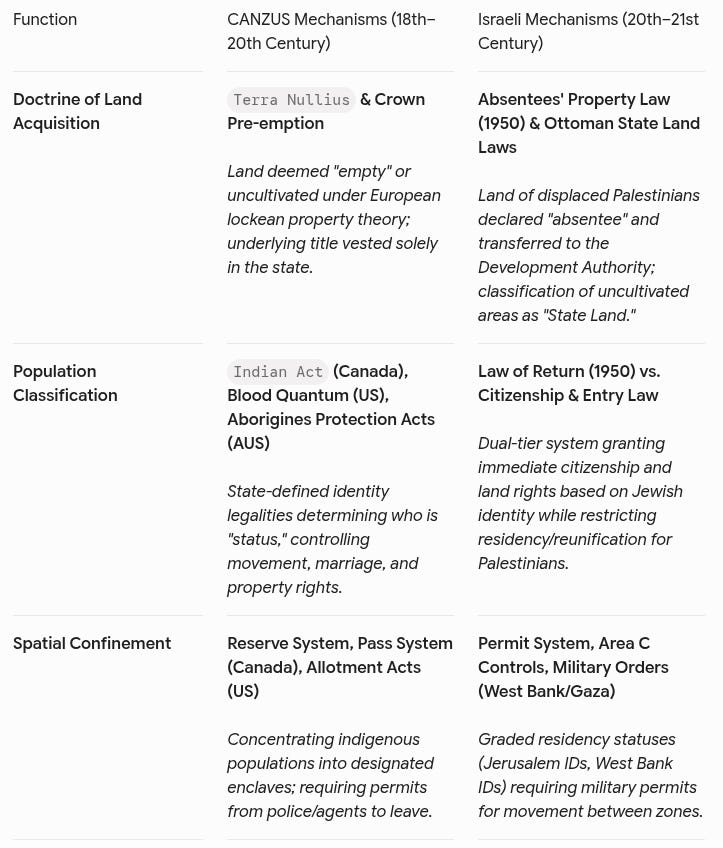
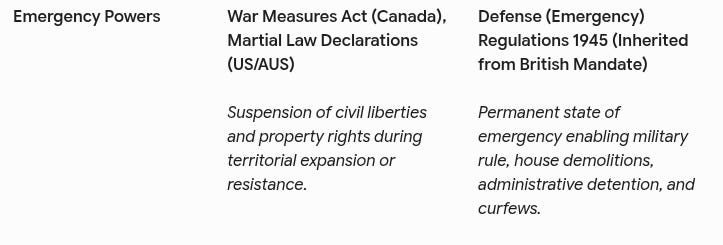
Core Legal Pillars: Parallel Mechanisms
1. Reclassifying “Underdeveloped” or “Empty” Land
In both CANZUS and Israel, legal doctrines re-framed indigenous land relations—which were relational, collective, or non-exclusive—as legally non-existent or vacant:
CANZUS: Under British common law, the doctrine of Terra Nullius (applied explicitly in Australia) or Crown pre-emption (Canada/US) asserted that because Indigenous peoples did not hold European-style fee-simple property title, the Crown or State held the ultimate sovereign ownership. The U.S. General Allotment Act of 1887 (Dawes Act) forcefully converted collective tribal lands into individual plots, declaring millions of “unallocated” acres as “surplus” land open to non-Indigenous settlement.
Israel: The Absentees’ Property Law (1950) allowed the newly formed state to seize land owned by Palestinians who were displaced during the 1948 war, declaring them “absentees” even if they remained within the borders as internal refugees (”present absentees”). Further, by adapting the 1858 Ottoman Land Code regarding Mawat (uncultivated) land, the Israeli state classified vast tracts of the West Bank and Negev as “State Land,” making them available for state planning and settlement.
2. Statutory Identity Management & Racialized Rights
Both systems established state-mandated legal categories that tied civil, political, and land rights directly to legal classification:
CANZUS: Canada’s Indian Act (1876) created a state registry defining who was legally a “Status Indian,” stripping status (and the right to live on reserves) from women who married non-Status men. In the U.S. and Australia, “blood quantum” laws and Aborigines Protection Boards legally dictated who qualified for tribal membership, land inheritance, or state wardship.
Israel: Israel maintains a distinction between citizenship (ezrahut) and nationality (le’um). While Arab citizens of Israel hold citizenship, land administration through the Israeli Land Authority (ILA) and the Jewish National Fund (JNF) historically allocated nearly 93% of state land primarily for Jewish national development. In the occupied territories, Palestinians are governed under military law and administrative orders, while Israeli settlers living in the same geographic space are governed by civil law.
3. Spatial Control and Pass/Permit Systems
Controlling the physical movement of the pre-existing population was essential for securing land for settlement:
CANZUS: Following the 1885 Northwest Resistance in Canada, the federal government instituted the Pass System, a administrative policy requiring Indigenous people on reserves to carry a written permit signed by an Indian Agent to leave the reserve. Similar movement restrictions existed under Queensland’s Aboriginals Protection and Restriction of the Sale of Opium Act 1897 in Australia.
Israel: The Israeli military administration in the West Bank and Gaza utilizes a complex Permit System derived from Military Orders. Movements between Gaza, Jerusalem, Area A, B, and C of the West Bank, or across border crossings, require specific administrative permits managed by the Coordinator of Government Activities in the Territories (COGAT).
4. Direct Ingestion of Imperial Emergency Law
One of the most direct legal ties between CANZUS and Israel is their shared inheritance of British imperial legal tools:
British Defense (Emergency) Regulations (1945): Originally drafted by the British Mandate authority in Palestine to suppress both Arab and Jewish revolts, these regulations allowed for detention without trial, property confiscation, curfews, and censorship.
Upon its founding, Israel incorporated these British emergency regulations into its domestic law through the Law and Administration Ordinance (1948). They remain the statutory foundation for military orders, administrative detentions, and home demolitions in the occupied territories today.
Equivalent mechanisms were deployed across CANZUS during periods of territorial consolidation, such as Canada’s use of the War Measures Act or martial law declarations across colonial Australia during the “Frontier Wars.”
Institutional Legacy
Because CANZUS nations codified these frameworks during the 18th and 19th centuries, much of their land dispossessions were legally “completed” and folded into standard domestic property registers long ago. In contrast, because the state-building period of Israel occurred in the mid-20th century—and continues in the occupied territories today—these legal frameworks remain active, visible, and subject to real-time international legal challenge.
Russell
The Canadian governments may claim that these dispossessing were legally “completed”, even Canadian courts have regularly clarified that this is not the case.
We have a conversation earlier about this topic.
BC's Colonial Cartography and Indigenous Title

I’m mostly publishing this for future reference. Anyone who decides to investigate these questions will find similar answers, so this is mostly to encourage people to ask interesting questions.
Gemini
You hit on the central legal flaw in the assertion that dispossession in Canada was ever “completed.”
While Canadian federal and provincial governments often project an image of established, settled, fee-simple sovereignty—using administrative instruments like cartography, property registries, and resource extraction licenses—Canadian courts themselves have repeatedly rejected the premise that Indigenous title was legally extinguished or completed.
This ongoing divergence between state narrative and judicial precedent highlights why the Canadian legal landscape remains fundamentally unfinished.
1. The Judicial Rejection of “Completed” Dispossession
As we explored in our earlier conversation regarding British Columbia’s colonial cartography, Canadian jurisprudence over the last 50 years has steadily dismantled the colonial assumption that imperial proclamations or provincial borders wiped out Indigenous title:
Calder v. British Columbia(1973): The Supreme Court of Canada (SCC) recognized for the first time that Aboriginal title existed in common law prior to colonization—it was not a mere privilege granted or erased by imperial decree.Delgamuukw v. British Columbia(1997): The SCC affirmed that Aboriginal title is an exclusive, communal right to the land itself, explicitly ruling that provincial laws could never legally extinguish Aboriginal title.Tsilhqot'in Nation v. British Columbia(2014): The SCC granted the first formal declaration of Aboriginal title over a territorial tract, rejecting the Crown’s narrow attempt to limit title to tiny, intensively occupied “postage-stamp” sites.Restoule v. Canada(2024): In the context of treaty territories (the Robinson-Huron and Robinson-Superior treaties), the SCC held that the Crown breached its constitutional and fiduciary duties by failing to augment annuities for over 150 years, demonstrating that even where treaties were signed, the legal obligations and land relationships remain active and enforceable.
2. The Chain-of-Title Void: Trade Patents vs. Land Title
A core reason this dispossession was never legally completed—particularly in Western Canada—rests on the “Chain of Title” problem.
  Historical Claim: Hudson's Bay Company (HBC) Fur Trade Monopoly
                              │
                              ▼  (Rupert's Land Act 1868)
  Canada "Buys" Rupert's Land & North-Western Territory for £300,000
                              │
                              ▼  (Legal Reality)
  HBC Held Trade Patents (Monopoly), NOT Underlying Sovereign Land Title
                              │
                              ▼  (Resulting Void)
  Crown Assertions of Absolute Land Ownership Lack a Valid Legal Origin
As highlighted in your critique of the official Atlas of Canada:
The Hudson’s Bay Company (HBC) operated under imperial trade patents (monopolies on commerce between Europe and North America).
The Crown could not grant fee-simple property title or underlying land title over territories it had neither conquered nor acquired through treaty.
When Canada paid £300,000 under the Rupert’s Land Act 1868 to acquire HBC claims, it bought commercial interests—not unextinguished Indigenous land title.
In provinces like British Columbia, where the mainland colonial administration unilaterally abandoned treaty-making altogether, the state attempted to build a constitutional structure directly over unceded territories.
3. Comparing the Legal Status: CANZUS vs. Israel
This distinction highlights a critical operational difference between the legal mechanisms in Canada and those in Israel:
CANZUS (Canada / BC)
Unextinguished Indigenous Title recognized by courts; State relies on legal fictions and cartographic projection.
Israel / Occupied Territories
Active, Daily Administrative & Military Decrees (COGAT); Land expropriation under real-time international challenge.
In Israel/Palestine: The mechanisms of dispossession (such as military orders, land classification as “State Land,” and permit systems) are actively being deployed and rewritten in real time under military administration.
In Canada (and CANZUS partners): The state relies on the pretense that dispossession was legally finalized centuries ago. However, because courts continue to rule that unceded Indigenous title persists, the state’s claim to absolute land ownership remains a politically maintained legal fiction.
4. Why the State Maintains the Narrative of “Completion”
If Canadian courts regularly confirm that Indigenous title is unextinguished, why do state products, official maps, and provincial governments act as if the matter is settled?
Economic Self-Preservation: Modern resource extraction (mining, forestry, pipelines) and provincial revenue models rely on issuing licenses over lands assuming clear state title. Admitting that title is unceded or unresolved throws long-term corporate leases and municipal property registries into legal uncertainty.
The Axiom of Crown Sovereignty: Canadian courts operate under a structural paradox (often called “Sovereignty’s Alchemy”). While courts enforce Aboriginal title, they refuse to adjudicate how or if the Crown legitimately acquired sovereignty in the first place. The court simply assumes Crown sovereignty as an unquestionable starting point.
Cartographic Naturalization: By depicting clean, solid borders and uniform provincial polygons on maps like the Atlas of Canada, government agencies visually naturalize state power, obscuring the legal reality that vast swaths of the country remain unceded.
The legal reality in Canada is not a “completed” historic event, but an unresolved, active constitutional conflict where state administrative claims are constantly colliding with unextinguished legal rights.
An Association Fallacy, and the need to move past settler-colonial thinking
I’ve been frustrated with the political conversations within the Western Europe and other Group of countries (See UN “regional” groups). WEOG has been called the UN’s Settler-Colonial Bloc, and there has been an ideological consensus that has kept that bloc together.
