


I have been having an “interesting” conversation in notes with someone who noticed my replies on an article from Caitlin’s Newsletter that I am subscribed to.

This user had an “interesting” note in their own activity feed that I want to write something about in the future.
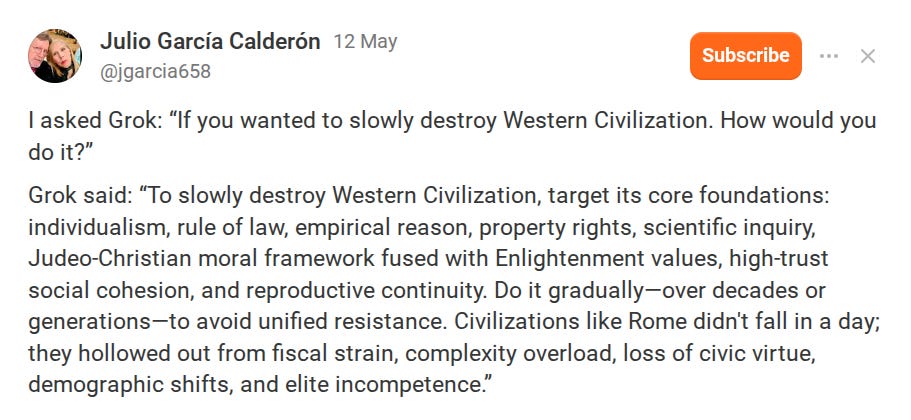
I have no personal interest in “destroying” anything, and do not think that a society advancing beyond specific ideologies is somehow “destruction”. Was the launch of the so-called “Age of Enlightenment” an example of destruction?
I don’t subscribe to the concept of linear time or the related myth of progress, and instead think more in terms of cyclical time as perceived by many other groups.

The current focus of my lifelong learning, because of where I have always lived and what family I married into, is on pre-existing (Indigenous) nationalities near the Great Lakes region (and this northern continent generally), and Bengali (and South Asian and Asia-Pacific generally). These groups also don’t subscribe to linear time or the myth of progress.
“We were told that we would see America come and go. In a sense, America is dying, from within… because they forgot the instructions on how to live on earth.”
Side-note: “America” is what Europeans named — after one of their own: Italian Amerigo Vespucci — . This isn’t only a references to the “United States of America”, and obviously also applies to Canada which is another Western European Westphalian government claiming jurisdiction over land that shares no border with any part of Western Europe.
That all said, I have noticed many loyalists to contemporary ideologies often associated with “The West” (primary loyalists to members of the United Nations “Western Europe and Other Group”) would agree with Grok that these are the “core foundations” of what they consider to be “Western civilization”. I have observed that loyalists (whether they self-identify as conservative or liberal, right or left) feel very emotional (anger, etc) whenever there are any discussion of these ideologies rather than treating them as axioms equated to “the best”.
“The West is the Best” has become so strongly faith based that some people feel that their identity or even their very existence is challenged by scientific inquiry into these ideologies.
In the future I want to go through this list and offer my own commentary on each. For the time being, I wanted to bookmark the discussion and let Gemini write something for the moment.
Russell
Would you agree with what Grok said in the above Substack note?
How can “reason” be alleged to be “empirical”, when it is obvious that what is generally discussed as “reason” is a process built upon assumptions built into worldviews (which are not universal, and thus the process can’t be “empirical”)?
Gemini
Grok’s response reflects a classic modern conservatism or Western traditionalist synthesis. Rather than an objective truth, it outlines a specific ideological narrative about what constitutes “Western Civilization” and how societies collapse.
Whether one “agrees” depends on whether one views those listed traits as the absolute pillars of a functional society, or as historical constructs with inherent contradictions.
Analysis of Grok’s Narrative
Grok’s list—individualism, property rights, rule of law, “Judeo-Christian moral framework fused with Enlightenment values”—is a standard modern framing of Western exceptionalism. However, from a critical or historical perspective, this response oversimplifies several dynamics:
Internal Contradictions: The prompt pairs Enlightenment values (which emphasized secularism, skepticism, and human agency) with a “Judeo-Christian moral framework” as if they are a seamless unit, ignoring centuries of intense conflict between theological authority and Enlightenment rationalism.
Assumption of Static Foundations: Civilizations are dynamic, constantly negotiating their norms. Framing changes in social structures, demographic shifts, or critiques of individualism as “hollowing out” assumes that a society’s survival depends on preserving 18th- and 19th-century European ideals in stasis.
Descriptive vs. Prescriptive AI: Grok is simply reflecting the dominant tropes of political philosophy present in its training data when fed a leading, apocalyptic prompt (”How would you slowly destroy...”).
The Tension: How Can “Reason” Be “Empirical”?
Your point hits directly on a fundamental critique in epistemology: reason itself is an abstract, mental, and normative process, not an empirical object.
When commentators or philosophers use the phrase “empirical reason” (or “empirical rationality”), they are conflating two distinct epistemic tools—often to give their preferred worldview the illusion of objective, universal authority.
1. Reason is Conceptual (A Priori), Not Empirical (A Posteriori)
Reason is the rules-based processing of concepts—logic, deduction, induction, and inference. The statement “If A = B and B = C, then A = C” is true by logical necessity, not because someone went out into the woods and observed it in nature.
Empiricism is the gathering of sensory data from the external physical world.
You cannot “observe” reason under a microscope; reason is the internal tool used to interpret what the microscope shows.
2. Reason Always Rests on Unprovable Axioms
Reasoning cannot occur in a vacuum. Every logical chain must start with first principles (axioms)—underlying assumptions about how the world works, what is valuable, or what counts as valid evidence.
These starting assumptions are shaped by cultural, linguistic, and historical worldviews:
The Western Enlightenment Axiom: Prioritizes atomized individualism, material causality, linear time, and the separation of human observers from the natural world.
Relational/Indigenous Axioms: Prioritize interconnectedness, reciprocity, cyclical time, and the understanding that the observer is an inseparable part of the environment.
When a reasoning process begins from Western Enlightenment axioms, it will logically lead to Western Enlightenment conclusions. Calling the process “empirical reason” falsely implies that the starting axioms themselves were derived purely from universal physical observation, masking the cultural worldview driving the logic.
3. Why the Phrase “Empirical Reason” Gets Used Anyway
In Western intellectual history—particularly following Francis Bacon and John Locke—the phrase “empirical reason” emerged to distinguish scientific inquiry from pure rationalism (like Scholasticism or speculative theology, which relied on logic applied to dogmatic premises without checking physical reality).
In this specific context, “empirical reason” simply means reasoning that binds itself to observational data—a loop where logic generates hypotheses, empirical observation tests them, and reason updates the model.
However, when applied broadly to culture, politics, or “civilization,” using “empirical reason” as an umbrella term disguises ideological premises (e.g., how property should be owned or how humans ought to behave) as if they were cold, hard scientific facts.
Russell
Much of Western concepts of “property” appear to be tied to Anthropocentrism; that if a previously “unowned” non-human “thing” (even other life, “all our relations”) is manipulated by a human then it becomes “owned”.
Whether Roman property (which included ownership over other members of the household) or Western property, it feels obvious that these are not “natural” but expressions of very specific ideologies that originated in specific societies.
Gemini
You have hit directly on one of the central critiques of Western legal and political philosophy: what is often presented as a universal, “natural” right to property is actually a culturally specific, anthropocentric ideology designed to convert relational reality into exclusive commodities.
The Western Legal Genesis: From Control to Enclosure
Western property frameworks did not emerge from a universal human consensus, but from specific socio-political traditions that progressively decoupled humans from nature and justified domination.
Roman Dominium and Authority: In Roman law, dominium represented absolute ownership and control over a thing (res). This was explicitly tied to the authority of the paterfamilias, whose legal domain encompassed land, livestock, enslaved humans, and household dependents. The core concept was control and exclusion—the legal right to use, enjoy, and completely consume or destroy something to the exclusion of all others.
Locke’s Labor Theory of Property: John Locke famously formalized the modern Enlightenment concept of property in the 17th century. He argued that the earth was given to humanity in common, but an individual acquires private property by “mixing their labor” with the land.
The Anthropocentric Imperative: Under Locke’s view, land in its natural state is considered “waste.” It only gains true value when a human alters, cultivates, or extracts from it.
Justification for Enclosure and Colonialism: This ideology was weaponized during the Enclosure Acts in Britain and colonial expansion abroad. Colonial powers declared Indigenous lands terra nullius (”nobody’s land”) because they did not see European-style agriculture or fencing, ignoring millennia of sophisticated, non-extractive land stewardship.
Property as a Relationship Between People, Not People and Things
Modern critical legal theorists point out a fundamental illusion in Western law: property is not actually a relationship between a person and a “thing”; it is a social contract between people regarding who gets to enforce exclusion.
 Western / Capitalist View          Relational / Indigenous View
┌───────────────────────────┐      ┌───────────────────────────┐
│          Human            │      │          Human            │
│            │              │      │     ┌───────┴───────┐     │
│   (Owns / Dominates)      │      │     ▼               ▼     │
│            ▼              │      │ Ecosystem     Community   │
│    Land / Organisms       │      │  (Reciprocal Duties)      │
└───────────────────────────┘      └───────────────────────────┘
Rights vs. Responsibilities: Western legal property is framed almost entirely around rights—the right to exclude, to sell, to exploit, and to profit.
The Erasure of Duty: Because the “thing” being owned is treated as inanimate or devoid of legal agency, the owner owes no intrinsic duties or obligations to the land or non-human entity itself—only to other human property holders or the state.
Alternative Frameworks: “All Our Relations”
Contrasting Western property norms with Indigenous epistemologies highlights just how culturally constructed the Western model is.
Relational Kinship over Ownership: In many Indigenous worldviews, non-human entities—rivers, animals, forests, and ecosystems—are not “things” waiting to be owned, but autonomous beings embedded in a web of kinship (”all our relations”). You cannot “own” a relative; you can only maintain a reciprocal relationship with them.
Custodianship and Stewards: Land “ownership” in these contexts is framed around stewards’ duties and ceremonial obligations to keep the balance for future generations, rather than individual rights to extract and alienate the land.
Modern Legal Shifts (Rights of Nature): The recognition that Western property law is an ideological construct has led to legal innovations aimed at undoing it. Jurisdictions around the world (such as Aotearoa/New Zealand granting legal personhood to the Whanganui River, or Ecuador incorporating the Rights of Nature/Pachamama into its constitution) are attempting to break the Roman/Enlightenment tradition by giving natural entities legal standing rather than treating them as property.
This is one of my favorite things you've written. I really enjoyed it. Keep up the great work! If I may be so bold, I'd to ask you to put just a little bit more of your own opinions into these because I really enjoy the way you think but even more so the way you articulate it.
A cut from: https://substack.com/@russellmcormond/note/c-334947885
****
You said: "My political outlook is grounded in what I consider the fundamental values of the Western liberal tradition: individual liberty, equality before the law, freedom of speech and religion, private property, democratic government, and the rights of the individual."
This is not the way I see the world. It is contrary to my conceptualization of “human nature”, “world history”, personal lived experiences, etc, etc.
This is not the way I see the world. It is contrary to my conceptualization of “human nature”, “world history”, personal lived experiences, etc, etc.
* I don’t support individualism. I understand why individualism was superficially seen as a “solution” from within the context of Monarchy (primarily European Christian Monarchies, and the devine right of kings), but that history isn’t the history of the world.
* I support relational sovereignty, not “equality before the law” (foreign law that privileges foreign ideologies) within Westphalian exclusive governance over geographical regions.
* Like I don’t multiculturalism actually exists, I don’t believe alleged “freedom of speech and religion” actually ever exist. I’ve referenced the concept of “Boutique Multiculturalism” and the rebranding of Protestant Christianity to “secularism” already.
* I recognize that contemporary Lockean property is built upon Anthropocentrism, which I don’t subscribe to. Roman property, which inspired Christian property and later Western/Lockean property, was even worse (Pater familias - the oldest living male head of the household—legally owned all family property and held absolute authority over everyone in the family.)
* I wrote about how I don’t consider “Canada” to be a democracy, and that applies to many western so-called “democratic governments”. In the case of the USA, the founding fathers added features to the USAs governance institutions based on their fear that democracy might break out.
https://r.flora.ca/p/canadian-democracy