


Earlier I discussed my own evolution of my understanding of the concept of “thanksgiving”, comparing to the Christian traditions I grew up in and those of the Haudenosaunee.
Thanksgiving

Growing up in a Christian family in the Christian country of the Dominion of Canada, thanksgiving was regularly focused on that religious community. Canada celebrates only one day a year, the second Monday in October.
Canadian Thanksgiving and United States Thanksgiving speak of different origin stories. While both speak of Western European Christian settler-colonialism and harvest times, US citizens often focus on a specific 1621 story about the Protestant Separatist Puritan Pilgrims at the Plymouth colony.
These weren’t your average subjects of European Christian Monarchies that were using the fundamentally racist Doctrine of Discovery to justify their false claims that the land was without peoples. These lands were only empty of Christians with specific anthropocentric ways of manipulating land and life to suit the specific desires of specific humans.
The Puritans were an extremely intolerant supremacist branch of Christianity that was less forgiving of what it considered “other” or “impure” (gender/women, sexuality, other religious beliefs, etc) than even other colonial Christians. I have regularly read how the Puritan work ethic prepared populations to submit to the most exploitative and hierarchical branches of Capitalism.
A different history?
In pop culture I have noticed that the extreme views of the Puritans have suggested that in hindsight, the Indigenous peoples that first met the Puritans should have killed them off rather than sharing knowledge as had been the norm for this continent.
One of the most amusing takes was from the Thanksgiving Play Scene in Addams Family Values (1993):
The Halluci Nation (formerly known as A Tribe Called Red) included the famous speech in a remix, and that has been used to create so many other videos.
Projection?
As so many Indigenous people I read, hear and interact with will tell you, the problem was never the civility, charity and hospitality of the peoples of this land towards other peoples as well as to more-than-human relations.
The problem was always with those who came from foreign lands, and rather than naturalizing to the laws and worldviews of this land, brought and fought to impose their foreign worldviews on this land.
A different story?
As I discussed in a recent interview, a big part of why I believe I’m able to more easily ask questions about what I was brought up to believe is that I don’t personally identify with specific worldviews.
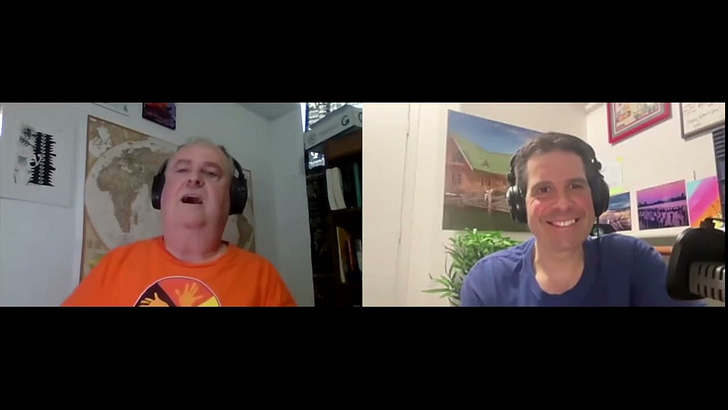
I am a lifelong learner, and am perfectly happy to admit that I don’t know something. I will publicly point out where I was wrong and what changed my mind. I’ve even pointed out that that younger versions of me would have a hard time having a conversation with older versions of me, as the younger version was trying to mimic the culture around me that would never admit we didn’t or don’t know something.

What if instead of US citizens looking at the Puritan Pilgrims at Plymouth as part of their National Identity, they thought of it as a cautionary tale of how not to think. The supremacist ideologies of those Puritans are still a dominant part of that culture, and rather than talking about one colony or one continent, they are regularly talking not only about an entire planet but also specific ideologies being allowed to lead space colonization.
A different story talks about how many people came to this land for a better life, fleeing problematic ideologies controlling their places of origin. It seems obvious to me that helping to free this land of foreign problematic ideologies should be core to their identity.

Who we are is a matter of stories, not biology, and I believe better stories need to become what we identify with if settler citizens of the USA and Canada are to ever move beyond rather than continuously repeating their problematic past.

I loved and appreciated every word