


This was going to be a small comment, but grew as there are many interconnected thoughts that I felt shouldn’t be trimmed so quickly. (And I doubted the idea I had a Gestalt mind…)

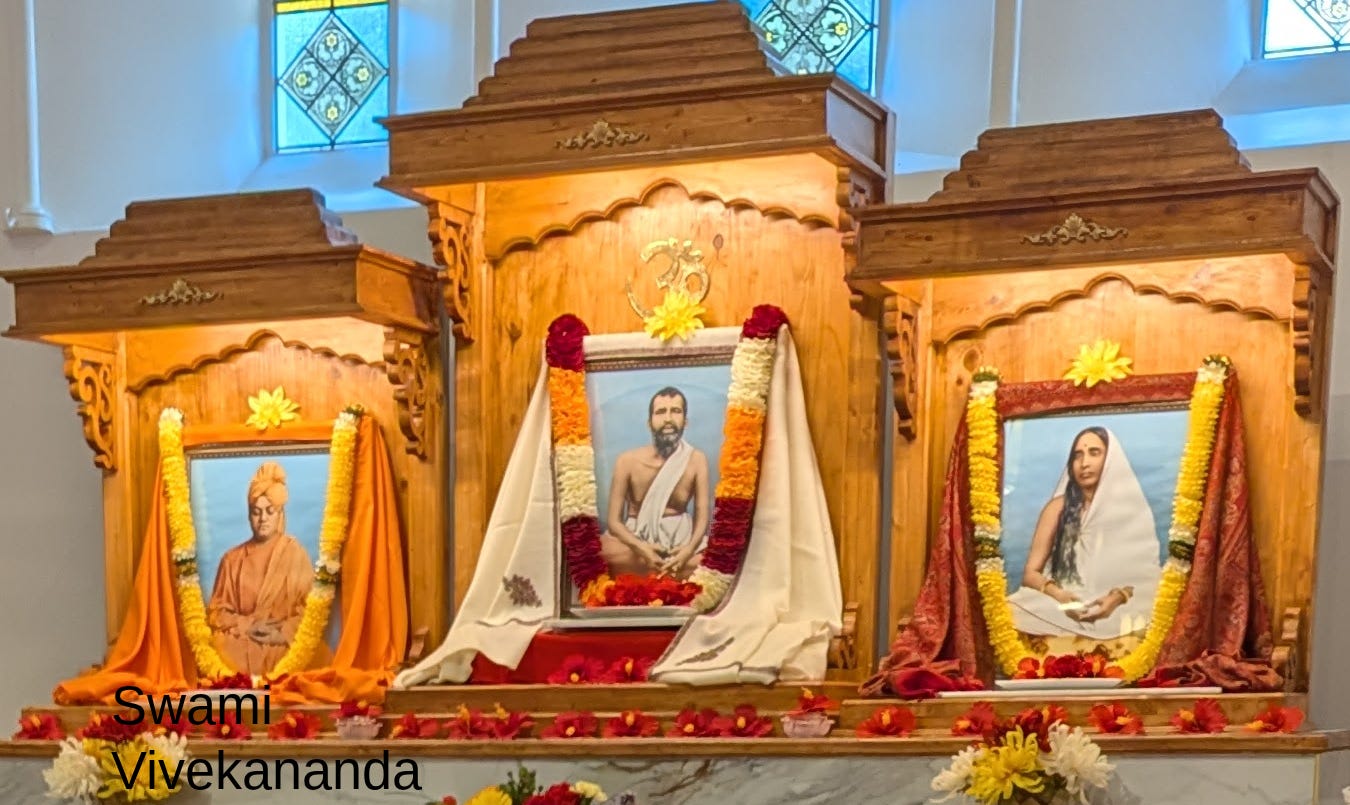
The Vedanta Society of Ottawa has a monthly class where Revered Swami Kripamayananda reads and discusses with us specific sections of the Books of Ramakrishna Order.
The group is currently reading from The Complete Works of Swami Vivekananda.
I attended yesterday (Thursday), and the class ended with a discussion of the first paragraph of the Introduction to Patanjali’s Yoga Aphorisms.
Given my other recent readings, I recognized this as a critique of Western European linear time and the myth of progress. I see so much overlap in my readings....
When Vivekananda was touring the West in the 1890s, the intellectual landscape was utterly consumed by the “Myth of Progress”. This is all part of the ongoing “Enlightenment” ideologies, something called “Whig history” (a new term for me) which views humanity as moving along a linear timeline from “primitive” to “civilized,” and would keep climbing an infinite, straight ladder of technological and moral advancement.
Just because Western Europe over a short period of its history went through specific steps, does not mean it relates to “humanity” (temporal or spatial). The Western European notion of “universality” is mythology, not science.
In many regions of North America, Indigenous societies (relational sovereign nationalities) strategically adapted their subsistence strategies (alternating between intensive agriculture and hunting-gathering) based on environmental shifts, population density, and resource availability. These dynamic shifts allowed communities to optimize survival without detriment to other relations (land and life), which is very different from Western European ideologies (Anthropocentrism, Androcentrism, Individualism, etc) which blindly believed in a strictly linear path from foraging to farming where humans are somehow disconnected from everything around them (and with the odd notion of individualism, disconnected from each other).
“Whig history” is yet another example of ongoing Western European (AKA: White) Supremacist thinking which taints much of the social, economic, and other theories that came out of (and continue to come out of) Western Europe and its colonial devotees.
Vivekananda was very polite to his Western audiences, allowing the term “modern” to be used when what was being discussed was merely the narrow ideologies forming from within Western Europe.
Another theory in modern times has been presented by several schools, that man’s destiny is to go on always improving, always struggling towards, but never reaching the goal. This statement, though apparently very nice, is also absurd, because there is no such thing as motion in a straight line.
(Note: I haven’t been reading in order, and read sections on JNĀNA-YOGA first, as I wanted to understand the concept of Māyā)
Vivekananda in other chapters expands on this introduction, and dismantles the entire “linear time” and “myth of progress” framework using two main arguments
1) The Trap of the Infinite Horizon
If the goal is always moving forward, and humanity is on a treadmill of endless “improvement” but never reaches a final destination, then existence is fundamentally a tragedy. It means humanity is trapped in a permanent state of lack. There is no ultimate peace, no final liberation (Moksha), and no absolute truth. All they see is an endless administrative grind toward a horizon that keeps receding.
2) The Law of Cycles (Samsara vs. Linear Time)
To counter the Western European notion of linear time, Vivekananda introduces the ancient South Asian cosmology of cyclical time.
In physics and in metaphysics, motion requires a starting point and a return. A straight line projected into infinity is an abstraction; in reality, everything in the universe moves in cycles.
The Macrocosm: Stars are born, collapse, and their dust forms new stars. Empires rise, decay, and fall. The universe itself undergoes creation (Srishti), preservation (Sthiti), and dissolution (Pralaya).
The Microcosm: A breath goes out and must come back in. A wave rises from the ocean and must crash back into it.
Within my anti-racism learning, I began to ask of “Diversity, Equity and Inclusion (DEI)” programs: inclusion into what?
Is this an environment that allows any “meat sack”, regardless of its visible attributes, to be included as long as everything else that makes someone human is left outside in order to conform? Since I started to think about this in 2021, I have come across the term “Boutique Multiculturalism” which is very related to this concept.

When I read the line “This statement, though apparently very nice, is also absurd”, I asked myself: nice for who? It appears to me the answer is that it is nice and convenient for the administrative Westphalian state and the political and economic elites that benefit from having a largely subservient workforce for their hyper-hierarchical social machinery.
To be clear, I’m not only seeing this as a critique of Capitalism but also the narrow critiques we can see within Socialism, Marxism/Communism, etc, that grew out of the same Western European “Enlightenment” worldviews. I know whenever there is discussion of “elites” there is a tendency for a debate between “your elites” and “my elites” between loyalists to Western European Conservatism vs Liberalism. I see the problem as the social hierarchies themselves, not which specific Western European ideologies are being forced on populations by which elites.

If you want to think more about how similar Marx, Engels, and others were in their ties to Western European “Enlightenment” ideologies (and the clear racism against the citilizations on the continent some call North America, others call Turtle Island, etc), you can also view:
10/10!!!!